
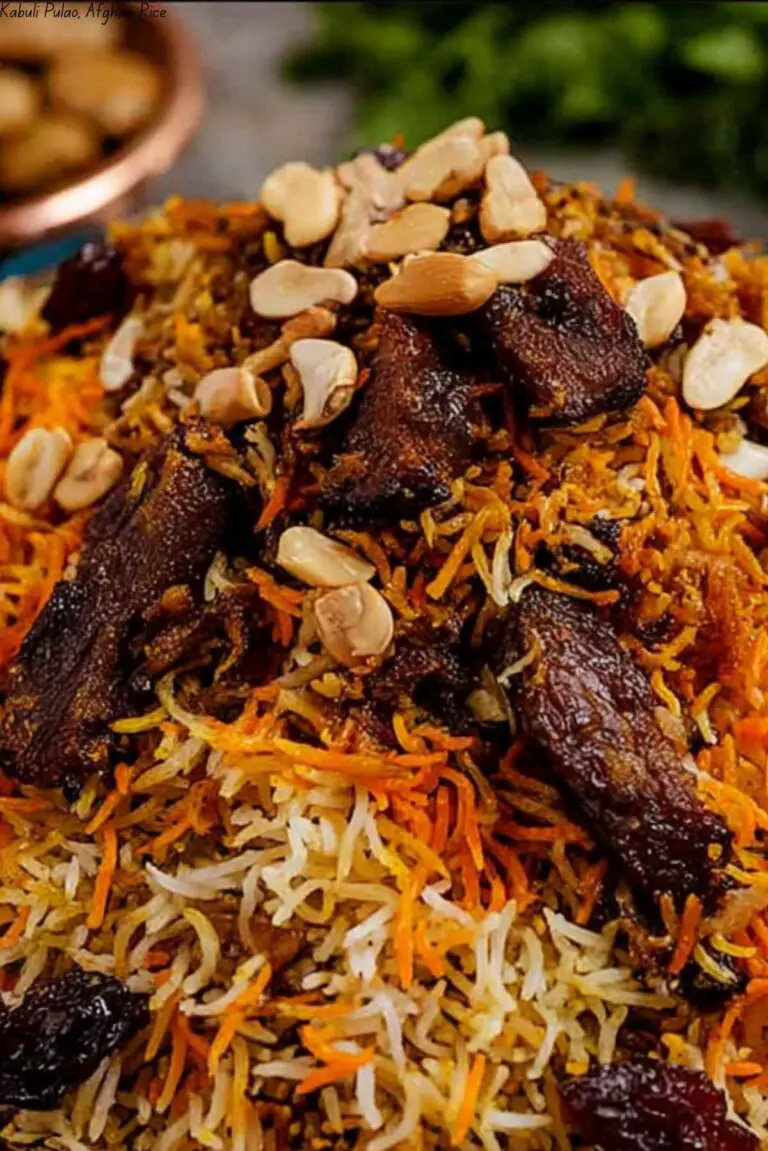
Afghanistan’s national dish is a study in contrasts. Tender lamb simmered until it falls apart. Fluffy basmati rice stained golden from caramelized sugar. Sweet, plump raisins and soft carrots sitting atop savory, spiced grains. Every element serves a purpose, and together they create something that feels ceremonial even on a random Tuesday night. This is the dish that sits at the center of Afghan tables during weddings, holidays, and any gathering worth remembering.
The technique is layered but not complicated. You build a rich broth by slow-cooking lamb with whole spices. You parboil rice until it’s just tender enough to snap between your fingers. You caramelize sugar into a dark syrup that colors and perfumes the grains. Then you steam everything together under a tight lid until the rice absorbs every drop of flavor and emerges separate, fragrant, and impossibly light. The carrot and raisin topping goes on at the end, adding sweetness and visual drama.
What Sets This Dish Apart
The rice is the star, not the meat. Unlike biryani where meat and rice compete, Kabuli pulao centers the rice. The lamb provides broth and richness, but the final plate is about those long, distinct grains glistening with oil and spice.
Sweet and savory coexist. The carrots and raisins aren’t garnish — they’re integral. That hit of sweetness against the savory, spiced rice is what makes this dish unforgettable. Skip them and you’ve made something else entirely.
Caramelized sugar changes everything. That dark syrup stirred into the rice doesn’t just add color. It adds a subtle bitterness and depth that balances the richness of the lamb fat. It’s the secret ingredient most people can’t identify but everyone notices.
Ingredients
For the rice and spice base:
- 2 cups basmati rice
- 2 teaspoons cumin seeds
- 5 green cardamom pods
- 1 black cardamom pod
- 4 cloves
- 2 inch cinnamon stick
- 1/3 cup cooking oil
- 1 1/2 to 2 lbs lamb shank
- 1 large onion
- 4 cloves garlic
- 1 1/2 teaspoons salt
- 1 teaspoon black pepper
- 4 cups water
For the topping:
- 1/2 cup raw almonds
- 2 cups shredded carrots
- 1 cup raisins
- 2 tablespoons sugar
How to Make It
Step 1: Prepare the rice Wash the basmati rice in a bowl, swishing it with your hands and draining repeatedly until the water runs nearly clear. This removes surface starch that makes rice sticky. Soak the cleaned rice in fresh water for at least 30 minutes. This step is non-negotiable — soaked rice cooks evenly and expands to its full length. Rinsing until water runs clear and soaking for 30 minutes is what gives you those long, separate grains.
Step 2: Build the broth Heat your cooking oil in a large, heavy pot over medium-high heat. Add the sliced onion and cook until it turns light golden and starts to crisp at the edges, about 15 minutes. Remove the onions and set aside. In the same pot, sear the lamb shank pieces until browned on all sides. Return the onions to the pot, add the garlic, cumin seeds, cardamom pods, cloves, cinnamon stick, salt, and black pepper. Pour in 4 cups of water and bring to a boil. Reduce to a simmer, cover, and cook until the lamb is fork-tender — about 1 to 1 1/2 hours. The broth should reduce and concentrate. Strain it, reserving the liquid and the meat separately. Slow-simmering lamb with whole spices creates a rich, aromatic broth that infuses every grain of rice.
Step 3: Prepare the toppings Soak the raw almonds in hot water for 10 minutes, then slip off the skins. Soak the raisins in warm water for 30 minutes until plump, then drain. In a skillet, heat a little oil and lightly toast the almonds until golden. Remove, then add the drained raisins and cook briefly until they swell. Remove, then sauté the shredded carrots in the same pan with a pinch of sugar until tender and slightly caramelized. Set everything aside. Cooking carrots and raisins separately with a touch of sugar creates the signature sweet topping.
Step 4: Make the caramel sauce In the same skillet, add 2 tablespoons of sugar over medium heat. Let it melt and darken to a deep amber — almost burnt, but not quite. Carefully add a splash of water and stir until the caramelized sugar dissolves into a thin, dark syrup. This is what gives the rice its characteristic golden-brown color and subtle smoky sweetness. Set aside.
Step 5: Parboil the rice Bring a large pot of salted water to a rolling boil. Drain the soaked rice and add it to the boiling water. Cook for just 4-5 minutes — you’re looking for grains that are soft on the outside but still have a firm core. They should break when pressed between your fingers but not be fully cooked. Immediately drain and rinse with cold water to stop the cooking. This parboiling step is crucial — finish cooking the rice in the broth and it will absorb flavor without turning mushy. Parboiling rice until it just breaks between your fingers ensures it finishes perfectly in the steam.
Step 6: Assemble and steam Return 3 cups of the strained lamb broth to your heavy pot. Taste it — it should be slightly salty since the rice will absorb the seasoning. Bring to a boil. Add the parboiled rice and stir gently. Place the cooked lamb pieces on top. Drizzle the caramel sauce over the rice. Scatter about three-quarters of the carrots and raisins on top. Cover the pot with a tight-fitting lid — wrap the lid in a clean kitchen towel if needed to seal it completely. Reduce heat to the lowest possible setting and steam for 25-30 minutes. No peeking. The steam trapped inside finishes the rice and melds the flavors. Steaming on the lowest heat with a sealed lid is what creates fluffy, separate grains.
Step 7: Serve with ceremony Remove the pot from heat and let it rest for 5 minutes. Fluff the rice gently with a fork, mixing the caramel color throughout. Transfer to a large serving platter. Arrange the lamb pieces on top or alongside. Scatter the remaining carrots, raisins, and toasted almonds over everything. The contrast of white and golden rice, dark meat, orange carrots, and dark raisins should look like a celebration.
Pointers Worth Following

Use a heavy pot. A thin pot won’t distribute heat evenly and you’ll end up with burnt bottom rice. Cast iron, enameled Dutch oven, or thick-bottomed stainless steel is ideal.
Don’t stir too much once the rice is in. After adding the parboiled rice to the broth, stir once to distribute, then leave it. Excessive stirring breaks grains and releases starch that makes everything sticky.
The towel-wrapped lid matters. It absorbs condensation that would otherwise drip back onto the rice and make it soggy. If your lid doesn’t fit tightly, use a towel.
Adjust liquid for your rice. Older basmati needs more water. Newer rice needs less. If you’re unsure, start with slightly less broth — you can always sprinkle more if the rice seems dry, but you can’t remove excess liquid.
Rest before fluffing. Those 5 minutes off the heat let the steam redistribute and the grains firm up enough to separate cleanly when fluffed.
Switching Things Up
Different proteins: Chicken thighs work well and cook faster. Beef chuck needs longer simmering but is equally rich. For a vegetarian version, use vegetable broth and add chickpeas or mushrooms.
Sella basmati: This parboiled rice variety is traditional and holds its shape even better than regular basmati. It needs slightly more water and longer cooking time but gives an authentic result.
Nut variations: Pistachios or cashews instead of almonds. Lightly crush them for more texture.
More spice: Add a pinch of saffron bloomed in warm water for luxury. A dash of ground cardamom or garam masala in the broth adds warmth.
Ghee finish: A drizzle of melted ghee over the finished rice adds richness and that restaurant-quality sheen.
What to Serve Alongside
A simple yogurt-cucumber salad (mast-o-khiar) provides cool contrast. Flatbread is traditional — you need something to scoop up stray grains. A sharp, vinegary salad with tomatoes and onions cuts through the richness. For drinks, mint tea is classic, though a cold beer works surprisingly well with the sweet-savory profile.
Keeping and Reheating
Store cooled pulao in an airtight container in the refrigerator for up to 3 days. The flavors actually improve as they meld. Reheat gently in a pan with a splash of water to prevent drying, or in the microwave covered with a damp paper towel.
Can you freeze it? Yes, for up to 2-3 months. Freeze rice and toppings separately if possible — the carrots and raisins soften faster than the rice. Thaw overnight in the fridge and reheat gently. Cooling completely before freezing and storing components separately preserves the best texture.
Questions That Come Up
Can I use chicken instead of lamb? Yes, bone-in chicken thighs work beautifully. They cook faster — about 45 minutes — and the broth is lighter but still flavorful.
Do I have to use the raisins? They’re traditional and add the signature sweet contrast, but if you truly dislike them, increase the carrots and add a touch more sugar to them during cooking.
Why is my rice sticky? Either it wasn’t rinsed well enough, was stirred too much during steaming, or too much liquid was used. Next time, rinse more thoroughly and measure your broth carefully.
Can I make this in a rice cooker? Not recommended. The layered technique — parboiling, then steaming with minimal liquid — doesn’t translate well to rice cooker mechanics. The stovetop method is worth the effort.
What if I don’t have black cardamom? Use extra green cardamom. The black adds a smoky depth that’s hard to replicate, but the dish is still excellent without it.
Why This Matters
Kabuli pulao is more than a rice dish. It’s a representation of Afghan hospitality — generous, aromatic, and built to feed a crowd. The technique of layering parboiled rice with rich broth, then steaming it to perfection under a sealed lid, creates something that tastes like it took all day when the active work is really about an hour. The sweet carrot and raisin topping against the savory, spiced grains is a flavor combination that lingers in your memory. Make it for a special occasion, or make it because it’s Tuesday and you want your kitchen to smell like something extraordinary.
Print
Kabuli Pulao, Afghan Rice
- Prep Time: 15 mins
- Cook Time: 1 hour
- Total Time: 1 hour 15 mins
- Yield: 4–6 servings 1x
- Category: Main-course
- Method: Stovetop
- Cuisine: Afghan
- Diet: Halal
Description
Kabuli Pulao is a fragrant Afghan rice dish cooked with aromatic spices, tender lamb shank, almonds, carrots, and raisins for a delicious sweet and savory flavor.
Ingredients
Main Ingredients:
- 2 cups basmati rice
- 2 teaspoons cumin seeds
- 5 green cardamom pods
- 1 black cardamom pod
- 4 cloves
- 2 inch cinnamon stick
- 1/3 cup cooking oil
- 1 1/2 to 2 lbs lamb shank
- 1 large onion
- 4 cloves garlic
- 1 1/2 teaspoons salt
- 1 teaspoon black pepper
- 4 cups water
Additional Ingredients:
- 1/2 cup raw almonds
- 2 cups shredded carrots
- 1 cup raisins
- 2 tablespoons sugar
Instructions
- Prepare Spices: Toast cumin seeds, cardamom, cloves, and cinnamon in oil. Remove and set aside.
- Brown Lamb: Brown lamb in the same pan, then add onion, garlic, salt, and pepper.
- Cook Rice: Add water, spices, and rice. Cook until rice is almost done.
- Add Extras: Stir in almonds, carrots, raisins, and sugar. Cook until rice is fully done.
Notes
- For a richer flavor, add ghee during cooking.
- Adjust salt and sugar according to taste preferences.
Nutrition
- Serving Size: 1 bowl
- Calories: 400 kcal
- Sugar: 20 g
- Sodium: 800 mg
- Fat: 15 g
- Saturated Fat: 3 g
- Unsaturated Fat: 10 g
- Trans Fat: 0 g
- Carbohydrates: 55 g
- Fiber: 5 g
- Protein: 20 g
- Cholesterol: 50 mg
… [Trackback]
[…] Info on that Topic: recipecoo.com/kabuli-pulao-afghan-rice/ […]
… [Trackback]
[…] Find More to that Topic: recipecoo.com/kabuli-pulao-afghan-rice/ […]
… [Trackback]
[…] Info on that Topic: recipecoo.com/kabuli-pulao-afghan-rice/ […]
… [Trackback]
[…] There you will find 68285 more Information to that Topic: recipecoo.com/kabuli-pulao-afghan-rice/ […]
… [Trackback]
[…] Read More to that Topic: recipecoo.com/kabuli-pulao-afghan-rice/ […]
… [Trackback]
[…] Read More to that Topic: recipecoo.com/kabuli-pulao-afghan-rice/ […]
… [Trackback]
[…] Find More on to that Topic: recipecoo.com/kabuli-pulao-afghan-rice/ […]